

by Amal Al-Takabari Department of Strategic Research, Studies and International Relations 10-10-2026
Introduction: A Question That Goes Beyond a Change of Leadership
One of the greatest mistakes in interpreting current developments in Libya may be to regard the removal of Aguila Saleh from the presidency of the House of Representatives as merely the end of a long parliamentary era. The event, which took place on 6 October 2026, coincided with the growing prominence of Saddam Haftar, American efforts to reunify state institutions, and the continuing competition for political, military, and economic influence across the country.
This coincidence does not establish that a single plan is orchestrating all these developments. It does, however, make it necessary to examine a deeper possibility: Has Libya entered a phase of reorganising its centres of power in preparation for a new political settlement? Or has the struggle shifted towards determining the nature of the authority that will replace the existing balance of power?
More importantly, this question concerns not only the future of Aguila Saleh or Khalifa Haftar, but also the future of the system that has taken shape in eastern Libya over recent years and its capacity to move from an order centred on a dominant military figure towards a sustainable political and military arrangement capable of surviving a change in leadership.
The question of post-Haftar Libya does not necessarily imply an imminent transition, nor does it presuppose his departure or a decline in his current influence. Rather, it constitutes a strategic question about succession and the continuity of the governing system—a question that should be addressed before succession develops into an actual crisis. Today, it has become a subject of serious consideration among various actors, including those closest to Haftar.
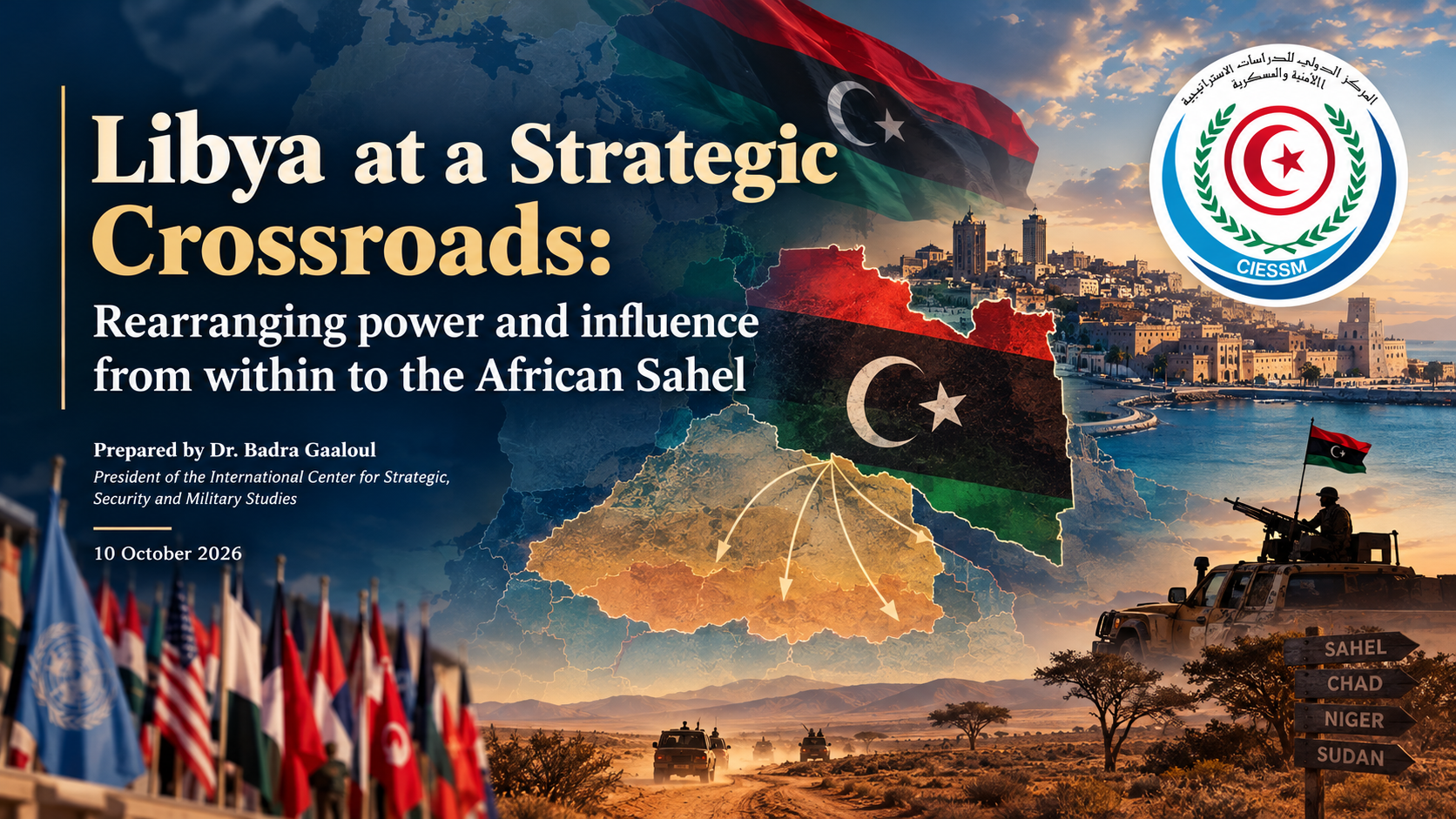
The significance of this question is heightened by the fact that Libya does not operate in a vacuum. The country lies at the intersection of international and regional interests and possesses energy resources, maritime access points, and extensive desert borders connected to an unstable security environment stretching across Sudan, Chad, Niger, and the African Sahel. Consequently, any change in the internal distribution of power may have repercussions extending beyond Libyan institutions to the surrounding regional balance.
The Removal of Aguila Saleh: Has the Dismantling of the Old Balance in Eastern Libya Begun?
On 6 October 2026, the House of Representatives, based in eastern Libya, brought Aguila Saleh’s twelve-year tenure as its president to an end, electing Al-Salihin Abd al-Nabi al-Obeidi as his successor, alongside Tareq al-Ashtar as First Deputy Speaker and Misbah Douma as Second Deputy Speaker. The change followed a vote in which 98 members of parliament supported amendments to the rules governing the presidency of the House, a move that prompted Aguila Saleh to challenge the legitimacy of the procedures.
These developments raise a question that goes beyond competition for the parliamentary presidency:
Why has a change in the leadership of the legislative institution become possible at this particular moment? And what might it reveal about the balance of power within the eastern camp?
The development cannot be reduced to a decision made by Saddam Haftar, nor is there sufficient evidence to conclude that Saleh’s removal was the direct implementation of an American directive. Nevertheless, recent reports have linked the decline of Saleh’s position to Saddam Haftar’s growing influence, as the latter has assumed a more prominent political and military role, as well as to differences over the course of a settlement with western Libya.
The deeper significance lies in the possibility that the removal of a prominent political figure, long associated with the governing system in the east, reflects a change in the relationship between the legislative institution and centres of military influence.
If the institution can renew its leadership according to stable and independent rules, this may represent a step towards restoring its institutional role. Conversely, if the change forms part of a broader transfer of decision-making authority towards more influential military actors, the legislature may become less capable of balancing executive and military power. In either case, Aguila Saleh’s political tenure appears to have reached its effective end, raising questions about his continued capacity to lead or represent the legislative authority.
Herein lies the paradox of the current phase: institutional leadership may change while actual institutional autonomy declines. The rules governing the distribution of positions may also change without resolving the fundamental question: who possesses the authority to make the final decision, and who has the capacity to obstruct it?
Accordingly, the real test for the new parliamentary leadership will not lie in its inaugural statements, but in its ability to make independent decisions, manage disagreements within the House, and participate in shaping a national settlement that does not merely confer political legitimacy on the existing balance of power.
Post-Haftar Libya: Is a Successor Being Prepared, or Is the Governing System Being Reconstructed?
Khalifa Haftar remains the central figure within the military system that dominates eastern Libya. However, the continuity of this system does not depend solely on the presence of its current leader. Whenever power becomes concentrated around a single individual, the question of leadership succession becomes part of the state’s future, even in the absence of any conclusive indication that a transition is imminent.
In this context, Saddam Haftar has acquired increasing significance. His military and political profile has strengthened in recent years, making him one of the most prominent figures associated with the future of leadership in eastern Libya. Recent developments indicate that his name has become increasingly prominent in discussions concerning political settlement and the relationship between military leadership and state institutions.
The strategic question, however, should not stop at whether Saddam will succeed his father. The more important question is whether the system built by Khalifa Haftar can transfer power to a new leader without becoming embroiled in disputes over authority, resources, and alliances.
Three dimensions are central to this assessment.
First: Military succession. Will leadership pass according to a clearly defined chain of command accepted by the principal centres of power within the military establishment, or will competition emerge over positions, jurisdictions, and operational decision-making?
Second: Political succession. Will a new leader be able to establish a stable relationship with parliament, the executive authority, and local forces, or will these institutions need to be reshaped to secure his influence?
Third: Economic and external succession. Will the capacity to manage resources and relations with external partners be transferred smoothly, or will competing interests emerge over who has the authority to negotiate and manage strategic portfolios?
These questions demonstrate that post-Haftar Libya concerns the continuity of the political and security order in the east, rather than the fate of a single individual.
The issue becomes more sensitive in light of reports suggesting possible differences between Saddam and his brothers, Khaled and Belqasim, over influence and the direction of a political settlement. However, such reports are insufficient to establish the existence of an open conflict or a definitive succession plan. They should be treated as indicators warranting further monitoring, rather than as conclusive findings.
If Saddam continues to accumulate responsibilities without significant resistance, this may indicate a gradual shift in the centre of gravity within the eastern leadership. If disagreements emerge over political representation, security arrangements, or foreign relations, however, succession itself could become a source of pressure on the cohesion of the system.
The more sensitive possibility is that the reorganisation of centres of influence may begin before leadership formally changes. Positions, powers, and alliances could be redistributed in ways that make the next phase less dependent on the previous balance of power and more dependent on the emerging leadership’s ability to consolidate its position.
This is a hypothesis that can be tested, not an established fact. Its analytical value lies in identifying the developments that should be monitored, rather than merely predicting the identity of a future successor.
Trump’s Initiative: A National Settlement or Recognition of the Existing Balance of Power?
These developments coincide with the United Nations-sponsored process, through which the parties reached an agreement on 30 August concerning preliminary steps towards an electoral process, with elections intended to take place within a period of up to 24 months. The two tracks do not necessarily constitute a single, integrated framework. Each must be assessed in terms of its substance and implementation mechanisms, rather than on the basis of similarities between their stated objectives.
Reports have referred to possible power-sharing arrangements involving figures from eastern and western Libya, including Saddam Haftar and actors associated with the government of Abdul Hamid Dbeibah. However, the details and potential outcomes of these arrangements have not been settled in a publicly announced final agreement that can be treated as an established reality.
This raises a question that may determine the future of the American initiative:
Is the settlement intended to build institutions capable of imposing rules on armed actors, or to bring the most influential political and military forces into shared arrangements that guarantee a minimum level of stability?
It cannot be concluded that Washington has chosen the latter course. Nevertheless, a risk arises whenever a settlement makes the consent of existing power centres a precondition for institution-building while postponing the question of bringing those centres under the rule of law.
Such a settlement might produce a unified government, economic understandings, and broader security coordination. Yet it could leave fundamental questions unresolved: Who has the authority to issue military orders? Who oversees public expenditure? How are oil revenues distributed? What safeguards prevent the use of force to impose political conditions? And who can guarantee elections whose outcomes are not controlled by existing centres of influence?
If these issues remain unresolved, institutional unification may become a mechanism for managing the balance of power rather than overcoming it.
More importantly, any agreement that grants a military leader an extensive political role may shape the period following Khalifa Haftar. If Saddam’s position is consolidated within a national settlement without clearly defined powers, oversight mechanisms, and accountability requirements, negotiations may shift from addressing the country’s fragmentation towards determining the position of the emerging leadership within the state.
Conversely, if political participation is linked to clear constitutional rules, a security command structure subject to civilian authority, and independent oversight of resources, the settlement could open a different path: a transition from the legitimacy of influence to the legitimacy of institutions.
The Risk That Agreements May Conceal: What Happens if Succession Precedes State Unification?
The most concerning scenario is one in which the reorganisation of leadership in eastern Libya advances more rapidly than the construction of national institutions. In such circumstances, power could be transferred within the existing system while the division between eastern and western Libya persists, leaving the armed forces, budget, oil sector, and electoral process subject to negotiations among competing centres of power.
This scenario does not require the outbreak of a large-scale war. It could instead take the form of competition over positions, disputes over jurisdictions, the obstruction of political understandings, or pressure exerted on economic infrastructure and strategic transport routes.
There have already been indications of the fragility of the unification process. On 3 October, The Guardian reported allegations linking Saddam Haftar to drone attacks against fuel and electricity facilities in western Libya during August, amid tensions surrounding negotiations. These are journalistic allegations and should not be presented as responsibility established by a judicial ruling or as definitive fact. Nevertheless, they form part of the political environment that must be considered when assessing the prospects for a successful settlement.
The significance of these allegations, irrespective of the need for independent verification, lies in the reminder that political negotiations are taking place in an environment where the parties possess instruments of military and economic pressure. If these instruments are used to alter the terms of negotiations, any agreement may become less stable and more dependent on a temporary balance among competing forces.
The transition towards a post-Haftar phase could therefore follow two contrasting paths: either the gradual reconstruction of the governing system within national institutions, or a transfer of authority within the existing system while the underlying causes of national fragmentation remain intact.
The distinction between these paths will not be determined by political rhetoric or the names of officeholders, but by the extent to which military and economic decision-making is subjected to institutional rules and mechanisms of accountability.
Southern Libya and Sudan: Whoever Controls the Routes Holds a Bargaining Chip
If eastern Libya constitutes the focal point of the succession question, the south represents one of the most important practical tests of any new political arrangement. The areas surrounding al-Kufra, Qatrun, and the borders with Chad and Niger are connected to networks of transport, trade, fuel distribution, and human mobility. Their strategic significance has increased further in the context of the war in Sudan.
A report by a United Nations Panel of Experts, document S/2026/224, documented the restructuring of supply networks associated with the Rapid Support Forces through southern Libya. According to the report, the Subul al-Salam Battalion and its commander, Abdulrahman Hashim al-Kilani, strengthened their control over supply chains between January 2025 and January 2026. These networks were reportedly used to transport fighters, weapons, and related materials from Libya to Sudan, with the implicit approval of the Libyan Arab Armed Forces, according to the report.
These findings are particularly significant because they do not merely concern competing political allegations; they derive from an assessment issued by a United Nations expert panel. Nevertheless, the report’s findings must be interpreted within their evidentiary limits, without extending responsibility to any actor beyond what the document actually establishes.
The strategic implication is that control over southern Libya is not simply a matter of border security. It affects the ability of different actors to monitor or disrupt supply routes and determines the degree of influence that armed formations can exercise in their relations with Libyan authorities and actors beyond the country’s borders.
If military institutions are genuinely unified, the state may become better equipped to monitor border crossings, pursue illicit networks, and regulate the movement of goods and people. If, however, the settlement is limited to distributing positions among political elites, multiple centres of control may persist even if political relations between eastern and western Libya improve.
This directly connects the question of post-Haftar Libya to the future of the south: will transport and supply routes fall under the authority of a unified national state, or will they remain part of an economy of influence in which the interests of armed formations, commercial networks, and regional actors overlap?
One possibility that warrants monitoring is that a redistribution of power within eastern Libya could alter the balance of control over these routes, with implications for supply networks associated with Sudan. It would nevertheless be inappropriate to assume that any leadership change will automatically interrupt or redirect these routes. Such outcomes will depend on actual decisions, networks of interest, and the state’s capacity to exercise effective oversight.
From Libya to the Sahel: Are Borders Becoming an Extension of the Struggle for Power?
Libya’s geography means that any change in control over its southern regions can have consequences extending beyond its national borders. The war in Sudan, instability in Chad and Niger, and the proliferation of armed groups across the Sahel all increase the strategic importance of desert corridors and transit areas.
This interconnectedness does not, however, imply the existence of a single regional system controlled by one actor. The borderlands are more plausibly understood as spaces in which overlapping and competing interests interact and evolve according to changes in the balance of power, resource availability, and conflict dynamics.
A change in control over a border crossing or transport route may shift pressure to another area, force networks to modify their routes, or strengthen one armed formation at the expense of another. If these developments coincide with the reorganisation of political authority in Libya, border regions may become part of an indirect bargaining process among Libyan and regional actors.
Conversely, if institutional fragmentation recedes and the state acquires effective monitoring capabilities, the south could gradually shift from a space characterised by multiple centres of control towards a region governed by a national security and economic policy.
The relevant question, therefore, should not be whether Libya will affect Sudan and the Sahel. Such influence already exists because of geography and established networks of movement. The more precise question is: Who will have the capacity to manage this influence, for what purposes, and under what system of oversight?
This question links the future of leadership in eastern Libya, the fate of the political settlement, and the security of the southern borders.
What Do External Powers Want from the Post-Haftar Phase?
The interests of the United States, Türkiye, Egypt, the United Arab Emirates, Russia, and European countries cannot be reduced to a single objective. Each has its own calculations concerning security, energy, migration, trade, and relations with Libyan actors. These interests may converge around preventing widespread instability or maintaining energy flows, while diverging over the form of the future political order and the distribution of military and political influence.
For Washington, institutional unification and elections constitute stated objectives. The real test, however, lies in the nature of the safeguards it seeks to establish. Will it prioritise a rapid agreement among actors capable of imposing stability, or will it also promote rules designed to prevent the settlement from producing a new monopoly on power?
For regional powers, any leadership transition in eastern Libya could alter existing channels of communication and influence, particularly if external actors differ in their preferences regarding the individuals who will lead the next phase. It should not, however, be inferred that all these powers are seeking to determine Haftar’s succession or have agreed on a particular candidate.
What can reasonably be argued is that a period of political reorganisation creates opportunities for external partners to influence the shape of a settlement, while giving Libyan actors opportunities to use external competition to strengthen their own positions.
The greatest risk, therefore, may not necessarily be direct foreign intervention. It may instead arise when domestic arrangements are shaped by short-term calculations of stability and the interests of external partners without establishing national safeguards against the concentration of decision-making authority or the reproduction of political fragmentation.
Prospective Scenarios for Post-Haftar Libya
Scenario One: An Orderly Transition in the East and Gradual Integration into a National Settlement
Under this scenario, the distribution of powers within the eastern leadership becomes clearer, and the American initiative and United Nations-sponsored process succeed in translating political understandings into implementable institutional measures.
Any political role assigned to military leaders would be linked to clear rules governing oversight and accountability, while progress would be made towards elections and the unification of national resources.
This would constitute the most constructive pathway, but it would require more than an understanding among political and military leaders. It would depend on institutions capable of implementing decisions and safeguards preventing disagreements from once again developing into struggles for control.
Scenario Two: Internal Succession Accompanied by Continued National Fragmentation
Under this scenario, a new leadership emerges within the eastern system, but national unification is delayed or remains partial. Leadership figures and alliances may change without fundamentally altering the distribution of power.
This scenario would not necessarily lead to armed confrontation. It could, however, entrench a political system in which formally unified institutions coexist with competing centres of decision-making in practice.
Scenario Three: Succession Rivalries Weaken Internal Cohesion
If sharp disagreements emerge over authority, military positions, or foreign relations, cohesion within the eastern camp could deteriorate, particularly if these disputes become intertwined with economic interests or new political arrangements.
This does not mean that a military split is imminent. Nevertheless, any indications of rejected decisions, shifting loyalties, or disrupted security coordination would be important in assessing the associated risks.
Scenario Four: Competition Shifts Towards the South and Strategic Resources
Competition may take a less direct form through pressure on transport routes, public utilities, economic facilities, or changes in control over border regions.
In this case, the conflict may not manifest itself as an overt confrontation over leadership. Instead, it may be expressed through the capacity to influence the movement of resources and cross-border flows.
This scenario would become more concerning if it coincided with the continuation of the war in Sudan and weak institutional oversight of supply routes.
Early-Warning Indicators to Monitor
To ensure that discussion of post-Haftar Libya does not remain a matter of political speculation, the following verifiable indicators should be monitored:
- The distribution of military powers: Are clear decisions being issued to define the relationship between Khalifa Haftar, Saddam Haftar, and other military leaders, or do their respective jurisdictions remain overlapping?
- The relationship between parliament and the eastern leadership: Does the new House of Representatives exercise its powers independently, or is its capacity to challenge decisions and provide oversight diminishing?
- The substance of the American initiative: Are documents or publicly announced arrangements emerging that specify the powers of the executive authority and military leadership, or does the initiative remain at the level of declarations?
- The positions of regional powers: Are diplomatic contacts or public positions towards key Libyan figures changing, or are existing relationships continuing without clear indications of strategic repositioning?
- Southern Libya: Are patterns of control over al-Kufra, Qatrun, and border routes changing? If so, are these changes accompanied by the unification of command or by an expansion of the influence of particular armed formations?
- Supply networks to Sudan: Are the routes documented by the United Nations expert panel continuing to operate, or is evidence emerging of their disruption, redirection, or transfer to different actors?
- Oil and public expenditure: Are transparent and unified rules for managing national resources being adopted, or do disagreements over their administration and distribution persist?
- The electoral process: Are agreements being translated into clear legal and institutional procedures, or are disputes that previously obstructed elections recurring?
If simultaneous indicators emerge of changes in military authority, resource management, and control over the south, the hypothesis that Libya is undergoing a broader reorganisation of its centres of power would gain greater analytical support. Conversely, if developments remain disconnected and no institutional or operational links become apparent, the assessment should be revised rather than imposing a single explanatory framework on events that may have different causes.
Conclusion: The Real Struggle Is Not Over Haftar’s Successor, but Over the Nature of the State That Will Remain After Him
It cannot be established with certainty that a leadership transition in eastern Libya is imminent, that Washington has determined the identity of the future leadership, or that recent changes form part of a unified regional plan.
What can be inferred, however, is that the convergence of changes in the parliamentary presidency, Saddam Haftar’s growing prominence, American efforts to unify state institutions, and the continuing strategic importance of southern Libya within regional supply networks makes the question of post-Haftar Libya a strategic necessity rather than mere speculation about the future.
Libya faces a test that goes beyond the fate of individual figures: can the country transform existing centres of power into institutions governed by national rules, or will it merely redistribute authority among those centres?
If leadership changes within eastern Libya without the construction of independent institutions, national fragmentation may persist despite changes in personnel. If institutions are unified without placing military decision-making and resource management under effective oversight, the settlement may become a more stable mechanism for managing influence rather than eliminating it. If, however, new arrangements are linked to oversight, accountability, and elections, the current rebalancing of power could become an opportunity to build a more cohesive state.
The repercussions will extend to southern Libya and its borders, where control over routes and resources can affect cross-border movements and supply networks associated with Sudan and the Sahel. The scale and direction of this impact, however, will depend on developments on the ground rather than on assumptions about the existence of a comprehensive master plan.
The real strategic shock may be that Libya enters the post-Haftar phase politically before doing so formally: a phase in which succession is tested, powers are redistributed, and control over the state’s key instruments is contested, while national institutions remain unable to resolve the fundamental questions of sovereignty and unified decision-making.
“ While the central question has long been who will govern Libya after Haftar, the more important and consequential question is this: Will Libya move towards a state governed by institutions, or towards a new configuration that reproduces the same concentration of power under different faces and arrangements?”
This is the distinction between a transfer of leadership and state-building. It is also the distinction that will determine whether current developments pave the way for a national settlement or mark the beginning of a new chapter in the struggle for power within Libya and across its regional environment.